What happens when someone dies and they have bills?
Generally, the deceased person's estate is responsible for paying any unpaid debts. When a person dies, their assets pass to their estate. If there is no money or property left, then the debt generally will not be paid. Generally, no one else is required to pay the debts of someone who died.What happen to bank account when someone dies?
Most joint bank accounts include automatic rights of survivorship, which means that after one account signer dies, the remaining signer (or signers) retain ownership of the money in the account. The surviving primary account owner can continue using the account, and the money in it, without any interruptions.What happens to the energy when someone dies?
There may be some compacting—holding down of energy—in the heart center, to avoid energetic interaction with people” and that “At the beginning stages of death, the energy field starts to separate. The lower three bodies (layers of the energy field) break up and dissolve.What bills have to be paid after death?
Order of priority for debtsThese are the expenses in respect of the estate administration. Priority debts follow, to include bills for tax and Council Tax. Finally, unsecured debts are paid last. These include credit card bills, store cards and utility bills.
What Do You Do With Utility Bills When Someone Dies?
What are the signs of the last hours of life?
In the final hours of life, your loved one's body will begin to shut down.
...
Hours Before Death Symptoms
- Glassy, teary eyes that may be half-opened.
- Cold hands.
- Weak pulse.
- Increased hallucinations.
- Sleeping and unable to be awoken.
- Breathing is interrupted by gasps, or may stop entirely.
Is it illegal to withdraw money from a deceased person's account?
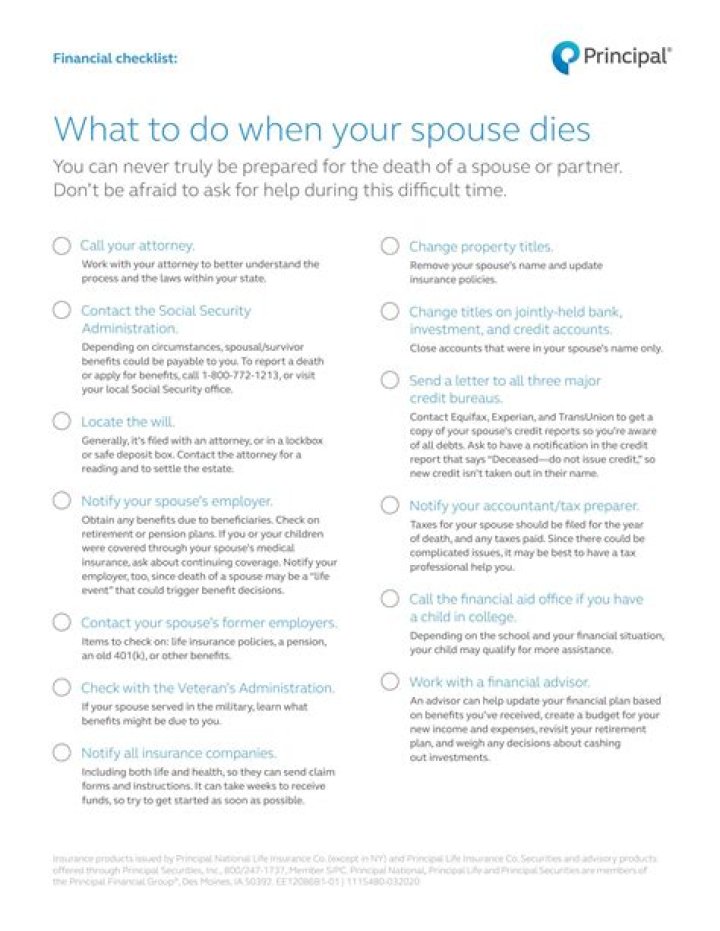
It's important to notify any relevant financial institutions as soon as possible after a death. Failing to do this, or continuing to use the person's bank card to make payments or withdrawals, is illegal.Do banks get notified when someone dies?
A family member sends a notificationThe main way a bank finds out that someone has died is when the family notifies the institution. Anyone can notify a bank about a person's death if they have the proper paperwork. But usually, this responsibility falls on the person's next of kin or estate representative.
Why do banks freeze accounts when someone dies?
When the owner of a bank account dies, the bank does not necessarily freeze that person's bank accounts. However, if the bank becomes aware of the account owner's death, it may freeze that person's account as a precautionary measure to prevent anyone from making unauthorized withdrawals.Is family responsible for deceased debt?
While there is a saying that death is a debt all men must pay, so too, it appears, is monetary loan to the extent of the debtor's estate. However, comfort may be found that heirs need not be burdened by such debt as the law limits their “share” to their portion of the properties and assets left by the decedent-debtor.What loans are forgiven at death?
Federal student loans are forgiven upon death. This also includes Parent PLUS Loans, which are forgiven if either the parent or the student dies. Private student loans, on the other hand, are not forgiven and have to be covered by the deceased's estate.Do children inherit debt?
You typically can't inherit debt from your parents unless you co-signed for the debt or applied for credit together with the person who died.Who notifies the bank of a death?
Family members or next of kin generally notify the bank when a client passes. It can also be someone who was appointed by a court to handle the deceased's financial affairs. There are also times when the bank leans of a client's passing through probate.How do I take money out of a deceased person's bank account?
The probate process may vary a bit but generally it will proceed more or less as follows: a judge will name a Personal Representative of the estate. The Personal Representative, with the help of the probate attorney, will submit the required paperwork to the bank and the bank will issue a check made out to the estate.What happens if no beneficiary is named on bank account?
If a bank account has no joint owner or designated beneficiary, it will likely have to go through probate. The account funds will then be distributed—after all creditors of the estate are paid off—according to the terms of the will.Can power of attorney withdraw money after death?
It's illegal to take money from a bank account belonging to someone who has died. This is the case even if you hold power of attorney for them and had been able to access the accounts when they were alive. The power of attorney comes to an end when a person dies.Can I use my father bank account after his death?
If the deceased has left deposit, then it has to be apportioned and used in accordance with the succession certificate issued by the competent court. Without succession certificate, withdrawing the deposits amounts to illegality. The institution should not allow such transactions without succession certificate.Do credit card companies get notified when someone dies?
Credit reporting companies regularly receive notifications from the Social Security Administration about individuals who have passed away, but it's better to also notify them on your own to ensure no one applies for credit in the deceased's name in the meantime.Can you empty a house before probate?
That answer is simple: no. The executor will have to wait until the probate process is over before disposing of assets.Can I use my moms debit card after she dies?
You cannot use your mom's debit card after she dies. Instead, you should notify the bank of her death and apply to the Surrogate's Court for approval to access her assets. After you notify the bank, they will freeze her accounts.Are joint bank accounts frozen when someone dies?
Are the assets frozen if someone on a joint bank account dies? No. Any remaining assets automatically transfer to the other accountholder, so long as the account is set up that way, which most are. Check with the financial institution if you're uncertain.What is the last breath before death called?
Agonal breathing or agonal gasps are the last reflexes of the dying brain. They are generally viewed as a sign of death, and can happen after the heart has stopped beating. Another strange and disturbing reflex that has been observed after death is called the Lazarus reflex.What are the 5 signs of death?
To figure out who is too dead to be saved, emergency responders look for five signs of irreversible death:
- Decapitation.
- Decomposition.
- Postmortem lividity.
- Postmortem rigidity.
- Burned beyond recognition.
What are the last moments before death like?
Facial muscles may relax and the jaw can drop. Skin can become very pale. Breathing can alternate between loud rasping breaths and quiet breathing. Towards the end, dying people will often only breathe periodically, with an intake of breath followed by no breath for several seconds.What to do immediately after someone dies?
To Do Immediately After Someone Dies
- Get a legal pronouncement of death. ...
- Tell friends and family. ...
- Find out about existing funeral and burial plans. ...
- Make funeral, burial or cremation arrangements. ...
- Secure the property. ...
- Provide care for pets. ...
- Forward mail. ...
- Notify your family member's employer.